
The Death of the Ritual: From Waterfall to the Post-Scrum Era
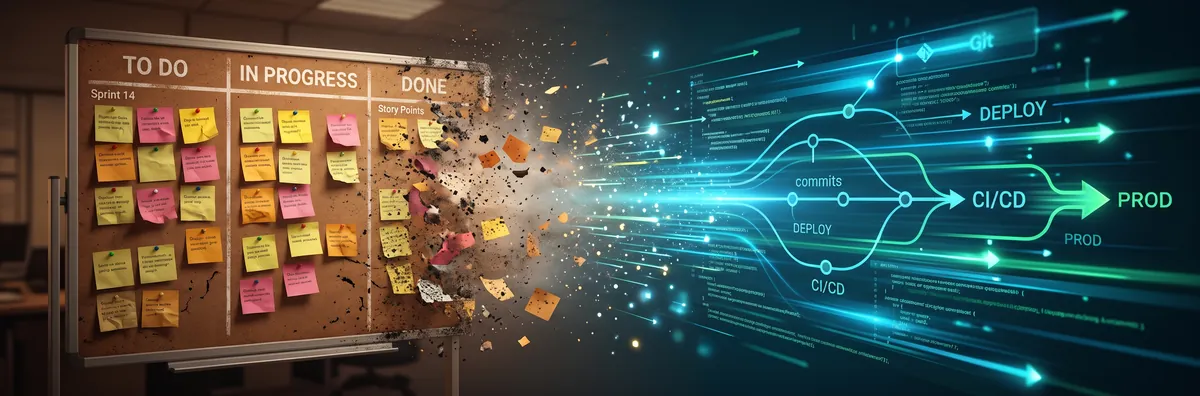
Table of Contents
Open Table of contents
- The Origin of the Friction: Why the Agile Manifesto Emerged
- The Corporate Trap: “Jirafication” and Textbook Scrum
- The Modern Era: Continuous Flow and the Death of the Backlog
- Comparison: Textbook Scrum vs. Continuous Flow
- Production Automation: What Flow Looks Like in Practice
- The Horizon: What Methodology Survives AI and Continuous Software?
- Additional Resources
The Origin of the Friction: Why the Agile Manifesto Emerged
To understand why contemporary rituals feel like empty friction, we need to examine the production environment that produced them.
In the late 1990s and early 2000s, shipping software was a brutal logistical operation. Code was burned onto physical CD-ROMs (“Gold Masters”), packaged in cardboard boxes, and loaded onto trucks bound for retail shelves. In early web services, deploying an update meant purchasing bare-metal rack servers, wiring them into a local colocation facility, and running manual database migrations during an anxious six-hour outage window on a Saturday morning.
Under those physical and economic constraints, the Waterfall model was rational engineering governance. When shipping an undetected defect meant hundreds of thousands of dollars in recalled physical media or weeks of customer downtime, exhaustive specification documents, architectural review sign-offs, and monolithic UML diagrams were practical risk mitigations.
In February 2001, seventeen engineers met in Snowbird, Utah, exhausted by bureaucratic processes like RUP (Rational Unified Process) and CMMI. Their core insight was straightforward: software is malleable, speculative documentation decays immediately, and responding to feedback generates far more value than sticking to an outdated plan.
The Agile Manifesto was not conceived to sell certifications or decorate boards with colorful sticky notes; it was an act of technical self-defense against release cycles that took two years to deliver a single binary.
The Corporate Trap: “Jirafication” and Textbook Scrum
The degradation began when large enterprises realized agility could be standardized, certified, and packaged into training catalogs.
During that corporate absorption, agile principles were displaced by an industrial complex of certifications: Certified Scrum Masters, SAFe release trains, and rigid process enforcement. Principles intended to foster developer autonomy were replaced by strict operational micromanagement:
- Manufactured estimates: Story Points and Fibonacci sequences were designed to communicate relative uncertainty, but traditional management quickly flattened them into disguised man-hours. When a team closes 40 points in one iteration, committing to 38 in the next is treated as an organizational failure.
- Scrum Theater: Backlog grooming stopped being a conversation about systems architecture; it turned into semantic disputes over whether refactoring an auth middleware delivers “direct business value” or must be smuggled inside an existing UI ticket.
- The fiction of the locked sprint: Freezing team scope for two weeks made sense when compiling, verifying, and testing took days. In a modern software market that shifts continuously, pretending reality pauses for ten business days is wishful thinking.
Warning: When team velocity measured in Story Points becomes a performance metric, Goodhart’s Law takes over: developers inflate estimates to shield themselves from bureaucratic scrutiny, rendering the metric useless.
The Divergence from Modern Infrastructure
While textbook Scrum remained frozen in 2010 assumptions, production infrastructure underwent a massive architectural overhaul:
- From bare-metal racks to elastic cloud primitives: Provisioning compute instances on AWS, GCP, or Azure takes seconds rather than months of hardware procurement.
- From manual FTP uploads to automated CI/CD pipelines: Code passing unit and integration suites builds and validates in 6 to 10 minutes.
- From semiannual releases to trunk-based development and feature flags: Modern engineering decouples binary deployment from feature exposure. New code lands in the main branch multiple times a day behind flags without exposing end users to risk.
This generated a glaring disconnect: engineering teams eliminated the technical barriers to continuous delivery, while management layers remained anchored to ceremonies built for boxed desktop software.
The Modern Era: Continuous Flow and the Death of the Backlog
High-performing product organizations (which inspired frameworks such as Basecamp’s Shape Up and The Linear Method) have discarded 14-day sprints and endless backlogs. They operate on continuous flow and variable-length focus cycles.
The governing principle is direct: instead of forcing engineering work into arbitrary two-week containers, teams resize the work so it flows directly to production as soon as it is verified.

1. Aggressive Slicing over Estimation Poker
Debating whether a feature is a 5, 8, or 13 is an unproductive exercise. If an initiative feels complex, experienced teams do not spend hours estimating it; they slice it.
The practical heuristic is clear: no Pull Request should exceed 300 to 400 lines of code or take longer than 48 hours to reach production behind a feature flag. By shrinking the batch size, lead time plummets in accordance with Little’s Law, and code review friction evaporates.
2. Ruthless Triage: Stale Backlogs are Mental Debt
Maintaining a backlog of 400 tickets that have sat unattended for nine months is not product planning; it is an emotional graveyard that drains cognitive focus during every triage meeting.
If a bug report or feature request is not acute enough to address in the current cycle, close it or archive it. If the issue matters, it will resurface with fresh context and real customer data. Product teams do not hoard speculative tasks; they maintain a lean board and focus on active priorities.
3. Asynchronous Visibility: The Daily Standup as a Status Call is Dead
When your daily development workflow links branches to issues, triggers automated test runs on each push, and notifies Slack or Discord when a PR merges to staging, gathering ten engineers at 9:30 AM to recite what they did yesterday is pure latency.
Status updates belong in the version control system and the CI pipeline. Synchronous discussions are reserved for genuine, multi-team architectural blockers that cannot be resolved in a technical issue thread.
Comparison: Textbook Scrum vs. Continuous Flow
The shift from ceremony-driven management to continuous flow can be summarized across core dimensions:
| Dimension | Textbook Scrum (c. 2010) | Continuous Flow / Post-Scrum (2026) |
|---|---|---|
| Delivery Cadence | Rigid 2-week sprint windows | Continuous flow with 1-to-3 day deliverables |
| Estimation Unit | Story Points, Planning Poker, Fibonacci | Aggressive task slicing (< 400 LOC batches) |
| Backlog Hygiene | Hundreds of stale tickets hoarded in Jira | Ruthless triage: unaddressed tasks get closed |
| Status Reporting | Synchronous 15-minute daily meetings | Asynchronous via Git events, PRs, and CI runs |
| Production Releases | End of sprint or coordinated release trains | Multiple times per day behind feature flags |
| Success Metric | Burndown velocity (points completed) | Lead time for changes, deployment frequency, stability |
Production Automation: What Flow Looks Like in Practice
In an engineering culture without ceremonial overhead, state transitions do not depend on a project manager manually dragging cards during a video call. They are triggered by verifiable events in the codebase.
Here is a minimal GitHub Actions workflow demonstrating automated verification, deployment, and status reflection:
# .github/workflows/continuous-flow.yml
name: Continuous Verification & Delivery

on:
  pull_request:
    types: [opened, synchronize, reopened]
  push:
    branches: [main]

jobs:
  verify:
    name: Lint, Test & Build
    runs-on: ubuntu-latest
    timeout-minutes: 10
    steps:
      - name: Checkout repository
        uses: actions/checkout@v4

      - name: Setup Node.js runtime
        uses: actions/setup-node@v4
        with:
          node-version: 22
          cache: 'pnpm'

      - name: Install dependencies
        run: pnpm install --frozen-lockfile

      - name: Typecheck and Unit Tests
        run: |
          pnpm run typecheck
          pnpm run test --run --coverage

  deploy:
    name: Rolling Production Deploy
    needs: verify
    if: github.ref == 'refs/heads/main'
    runs-on: ubuntu-latest
    steps:
      - name: Trigger Zero-Downtime Release
        run: |
          echo "Deploying release with active feature flags..."
          # Direct trigger to Kubernetes / Cloud Run / Vercel
          curl -X POST "${{ secrets.DEPLOY_HOOK_URL }}"
💡 Pro Tip: If you require a 45-minute synchronous sync to determine whether a feature is ready to ship, the root cause is not poor communication: it is an opaque deployment pipeline and oversized pull requests.
The Horizon: What Methodology Survives AI and Continuous Software?
With AI coding tools and autonomous agents capable of generating boilerplate, drafting unit test suites, and suggesting architecture refactors in seconds, the primary engineering bottleneck has shifted permanently.
The constraint is no longer the speed of typing code; it is system design, strict domain boundaries, verifying runtime correctness, and preserving architectural stability.
Attempting to constrain this velocity within an arbitrary two-week timebox is anachronistic:
- Work granularity has collapsed: When designing, validating, and iterating on a module takes hours rather than weeks, waiting for next sprint’s planning session slows the entire organization down.
- Compact teams, high technical leverage: Engineering teams no longer require fifteen-person squads encumbered by administrative coordination layers. Small pods of two or three engineers with deep product context and automated testing pipelines ship more reliably than sprawling ceremonial departments.
- The pivot to automated verification: Hours previously spent negotiating story points are reinvested into contract testing, synthetic production telemetry, and real-time observability.
When Does Traditional Scrum Still Apply?
To be fair, not every organization can transition to pure continuous flow overnight. Scrum retains utility in specific contexts:
- Fixed-fee consulting or RFP contract work: Where external clients demand upfront scope and cost guarantees before approving purchase orders.
- Teams with nascent technical infrastructure: If a team still relies on manual deployments or lacks automated test coverage, strict timeboxes provide scaffolding against total disarray.
- Heavily regulated compliance environments: Industries where changes require formalized Change Advisory Board (CAB) sign-offs before entering production pipelines.
For software organizations competing on speed, product quality, and engineering retention, clinging to textbook Scrum is relying on a 2005 roadmap for 2026 terrain. Modern tracking platforms (Linear, GitHub Projects) did not invent this movement—they are simply the byproduct of engineering teams choosing verifiable software delivery over procedural theater.
Additional Resources
- The Agile Manifesto (2001) — The original foundational text before enterprise co-optation.
- Shape Up: Stop Running in Circles and Ship Work that Matters — Ryan Singer / Basecamp.
- The Linear Method: Practices for High-Performance Teams — Principles of flow, autonomy, and backlog hygiene.
- Continuous Delivery: Reliable Software Releases through Build, Test, and Deployment Automation — Jez Humble & David Farley.